She Conceives And Infected One Tazria Metzora
Tazria-Metzora ÔÇÿShe Conceives' and ÔÇÿInfected One'
 The Holy Scriptures in Hebrew
Shabbat Shalom John,
Welcome to Tazria-Metzora (ÔÇÿShe Conceives' and ÔÇÿInfected One'), this week'sParsha (Torah portion).
These two portions of Torah are combined this week to accommodate the numberof Sabbaths this year and will be read in synagogues around the world duringthis week's Shabbat (Saturday) service.
Please read along with us. We know you will be blessed!
TAZRIA (She Conceives)-METZORA (Infected One)
Leviticus 12:1-15:33; 2 Kings 7:3-20; Luke 7:18-35; Matthew 23:16-24:2, 3-31
"The Lord said to Moses, ÔÇÿSay to the Israelites: A woman who becomes pregnantand gives birth to a son will be ceremonially unclean for seven days, just asshe is unclean during her monthly period.'" (Leviticus 12:1-2)
 This week’s Torah portion specifies laws of purification, including thosepertaining to childbirth. Yeshua’s mother, Miryam, would have diligentlyfollowed these laws and regulations.
While last week's Parsha (Shemini) dealt with Biblical dietary regulations,this week's study deals with the laws of tumah (ritual impurity) andtahara (ritual purity).
The laws pertaining to purification, including post childbirth, purity inmarriage (niddah), and leprosy are discussed.
These regulations may be understood in purely hygienic terms, or for theirreligious significance, or both.
The issue, however, is not one of clean versus unclean, but pure (tahor) versusdefiled (tameh).
Certainly, as Believers we strive to be pure and clean in heart beforethe Lord.
 This rabbi is reading from a Jewish prayerbook inthe synagogue before removing the Sefer Torahscroll, which is covered in an ornate mantle, fromthe Ark behind him.
The Biblical Regulations of Childbirth
"Then the woman must wait thirty-three days to be purified from her bleeding.She must not touch anything sacred or go to the sanctuary until the days of herpurification are over. If she gives birth to a daughter, for two weeks thewoman will be unclean, as during her period. Then she must wait sixty-six daysto be purified from her bleeding." (Leviticus 12:4-5)
The Bible specifies a waiting period for purification after childbirth-33 daysif a male child is born and 66 days if a female child is born.
It provides no explanation why the period of impurity (tameh) is double whena woman gives birth to a female child instead of a male child.
After the specified period of ritual impurity (as in the menstrual period), aburnt offering was brought to the priest.
When the days of her purification for a son or daughter are over, she is tobring to the priest at the entrance to the tent of meeting a year-old lambfor a burnt offering and a young pigeon or a dove for a sin offering. Heshall offer them before the Lord to make atonement for her, and then shewill be ceremonially clean from her flow of blood.
These are the regulations for the woman who gives birth to a boy or a girl.(Leviticus 12:6-7)
 A woman was to bring a year old lamb for a burnt offering and a young pigeonor a dove for sin offering when the required days of purification were completed.
Today, for ritual purity, a Jewish woman customarily visits the mikvah (ritualwater immersion) after childbirth before resuming sexual relations with herhusband. There are mikvahs in every orthodox Jewish community throughoutthe world.
As well, instead of the prescribed offering that was to be made at the Temple,today parents generally visit the synagogue in order to give thanks to God fora speedy recovery from childbirth and for the blessing of their newborn child.
This is when the female child is given her Hebrew name.
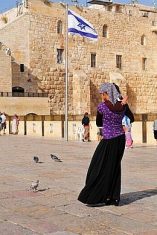 A mother and child at the Western (Wailing) Wallplaza, a remnant of the wall that surrounded thesacred Temple‘s courtyard.
The male child, however, is named at his brit milah (circumcision)on theeighth day.
"And on the eighth day the flesh of his foreskin shall be circumcised."(Leviticus 12:3)
In keeping with the Law of Moses, the Messiah was named YeshuawhenHe was eight days old, on the day of his circumcision (Luke 2:21).
"On the eighth day, when it was time to circumcise the child, He was namedJesus [Yeshua], the name the angel had given Him before He was conceived."(Luke 2:21)
[His Hebrew name, Yeshua, has been transliterated as ‘Jesus’ in Englishsince it comes from the Latin transliteration ‘Iesus.’]
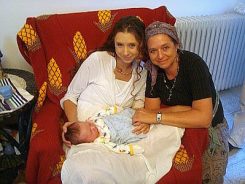 An Israeli mother proudly holds her son after his brit milah, while her ownmother beams beside her.
Biblical Regulations Concerning Leprosy
"Whoever of you loves life and desires to see many good days, keep your tonguefrom evil and your lips from telling lies." (Psalm 34:12-13)
Much of this Parsha concerns leprosy.
Although the word lepra is used in the Septuagint, and is translated as leprosyin English, in Hebrew, the actual word is tzaraat.
This word comes from tzara, means “to have a skin disease,” although the rootof tzaraat may actually mean “smiting.”
 The Hebrew word tzara is a broad term thought to encompass diseasessuch as leprosy, ringworm (see above photo), psoriasis, impetigo, andtropical sores.
While we automatically relate leprosy to the modern-day affliction ofleprosy, which is accompanied by swelling of organs and rotting of the limbs,a better translation might be "scaly affliction."
Three manifestations of tzaraat are mentioned in the Torah: an affliction ofhuman skin (Leviticus 13:2); an affliction of garments (Leviticus 13:47); andan affliction of houses (Leviticus 14:34).
A person afflicted with tzaraat was called metzora, and was to be isolated fromthe community in order to prevent defiling and infecting others through contact.
"Anyone with such a defiling disease must wear torn clothes, let their hair beunkempt, cover the lower part of their face and cry out, ÔÇÿUnclean! Unclean!'[Tameh! Tameh!] As long as they have the disease they remain unclean.They must live alone; they must live outside the camp." (Leviticus 13:45-46)
 Women praying at the Western (Wailing) Wall in Jerusalem.
According to rabbinical tradition, tzaraat is an affliction from God aspunishment for the very serious sin oflashon hara (evil tongue), which isdefined as true speech for malicious purposes; for example, in Numbers 12:10,Miriam was stricken with tzaraat after speaking evil of Moses and his wife.
Although lashon hara is an extremely serious sin, slander or defamation, whichis called hotzaat shem ra (spreading a bad name), is a graver sin.
Gossip, called rekhilut, is also forbidden by Jewish law.
Judaism considers malicious gossip a type of moral leprosy, an evil contagion,and the leper should be put outside the camp until they are healed.
"Do not go about spreading slander among your people. Do not do anything thatendangers your neighbor's life. I am the Lord." (Leviticus 19:16)
Also, when a house was infected with ÔÇÿleprosy,' the stones and timber infectedwith mildew or dry rot would be removed and carried off to a designated placeoutside the camp (Leviticus 19:44-45). If that didn't work, then the house wastotally dismantled.
Likewise, sometimes a situation in our lives or relationship has become sodefiled and unhealthy that it must be leveled to the ground. We must startover in a new place, trusting that God will help us to begin anew.
 Torah scroll with a yad (Torah pointer) for keeping one’s place while reading.
Spiritual Leprosy
How does all this apply to Believers in Yeshua (Jesus) today?
When it comes to sin amongst Believers, there must be an attitude of gracetoward the faults and weaknesses of others, but there must also be wisdom.
The Bible tells us to not fellowship with those who call themselves Believersand yet persist in serious sins-not even to eat with them! They must remainoutside the camp until they repent.
"But now I am writing to you that you must not associate with anyone who claimsto be a brother or sister but is sexually immoral or greedy, an idolater orslanderer, a drunkard or swindler. Do not even eat with such people.”(Corinthians 5:11)
Anyone who repents, however, can be cleansed of their sins through the bloodof Messiah Yeshua (Jesus).
 Christian pilgrims immersing themselves in the Jordan River in northern Israel.
Haftorah (prophetic portion)
In this week's Haftorah (prophetic portion) we read the story of Naaman,captain of the army of the King of Aram. He was a mighty man of valor butalso aleper (metzora).
Naaman's wife had an Israelite servant girl who was captured during an Arameanraid on Israel, and she advised that Naaman should go to the prophet Elishain Israel for healing.
Naaman eventually did go, but the experience was nothing that he expected.
Elisha didn’t personally meet with Naaman, but sent a messenger whoinstructed him to dip seven times in the Jordan River.
At first, Naaman took offense, since he expected a more personal touch. Hewas, after all, the captain of the army.
And then, to add insult to injury, he was told to wash in the insignificant,tiny Jordan River!
"I thought that he would surely come out to me and stand and call on thename of the Lord his God, wave his hand over the spot and cure me ofmy leprosy. Are not Abana and Pharpar, the rivers of Damascus, betterthan all the waters of Israel? Couldn't I wash in them and becleansed?" So he turned and went off in a rage. (2 Kings 5:11)
Fortunately for Naaman, his servants had the courage and faithfulness to challenge him.
Naaman repented of his attitude of pride and superiority, and obeyed the prophet.
 Elisha refuses the gifts of Naaman, by Pieter de Grebber
Naaman's Leprosy is Healed
When Naaman immersed himself seven times in the Jordan, his flesh became likethat of a little child (na'ar katan), and he was made clean (tahor-ritually pure).
This ritual water immersion is called the ÔÇÿmikvah'-the Jewish custom from whichthe Church derived the rite of baptism.
Furthermore, since seven is thenumber of perfection, rest, completion andwholeness in the Bible, when Naaman entered the mikvah and was immersed seventimes, he was healed mind, body and soul, and he believed in the God of Israel!
"Then Naaman and all his attendants went back to the man of God. He stoodbefore him and said, ÔÇÿNow I know that there is no God in all the world exceptin Israel. So please accept a gift from your servant.'" (2 Kings 5:15)
 Bar mitzvah boy (age 13) reading from the Sefer Torah scroll
Mankind can only find healing from moral leprosy in the teachings of theWord of God, in the rivers of the Living Water of the Jewish Scriptures, andtheir fulfillment in Yeshua the Messiah!