After The Death Acharei Mot And Holy Ones Kedoshim
Holy Confidence: this week's Torah reading is Acharei Mot (After the Death)-Kedoshim (Holy Ones)
 Sefer Torah scroll in a synagogue
Welcome to our Torah study.
This week, two Torah readings, Parsha Acharei Mot (After the Death) andKedoshim (Holy Ones), are combined to accommodate the number of Sabbathsin this calendar year.
Please read along with us, and discover Torah truths in this portion of Scripturethat is read in synagogues around the world this morning.
PARSHA ACHAREI (After)-KEDOSHIM (Holy Ones)
Leviticus 16:1-20:27; Amos 9: 7-15; Ezekiel 20: 2-20; 1Corinthians 6: 9-20
"The Lord spoke to Moses after the death of the two sons of Aaron who died whenthey approached the Lord." (Leviticus 16:1)
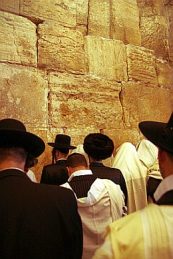 Jewish men seeking God in prayer at dawn at theWestern (Wailing) Wall, which is a supporting wallfor the TempleMount. It has remained intact sincethe destruction of the SecondTemple in 70 C.E.and is considered holy due to its proximity to thespot where the Holy of Holies once stood.
Last week's combined Torah portion, Tazria-Metzora, discussed the laws oftumah v'taharah, ritual impurity and purity.
This week's combined Torah portion, Parsha Acharei-Kedoshim, discussesYom Kippur (Day of Atonement) and holiness, and begins with Aharon, theCohen Hagadol (high priest), preparing for the crucial once-a-year sacrifice onthe Day of Atonement.
In order to minister before the Lord on this holy day, Aharon first immersedhimself in the mikvah (ritual cleansing).
Before he brought the ketoret (incense offering)into the Holy of Holies, theinnermost chamber of the Sanctuary, he donned simple, white linen clothing,representing purity and humility, which was appropriate for this sacred day,instead of his resplendent golden garments.
So too today, many observant Jewish people wear white linen when attendingYom Kippur services.
 Day of Atonement, by Isador Kaufman
Holy Confidence
"The blood will be a sign for you on the houses where you are, and when I seethe blood, I will pass over you. No destructive plague will touch you when Istrike Egypt." (Exodus 12:13)
The rabbis provide insight into the reason for wearing simple, white linengarments on this holy day:
When men are summoned before an earthly ruler to defend themselvesagainst some charge, they appear downcast and dressed in black likemourners. Israel appears before God arrayed in white, as if going to afeast, confidentthat all who return penitently to their Maker will receivenot condemnation but pardon at His hands. (The Pentateuch and Haftorahs, p. 480)
This speaks of a wonderful confidence in God and His provision for atonement.
 To symbolize purity, and a confident reliancein the mercy of God, many Jewish peoplewear white on the Day of Atonement.
The Blood Sacrifice
"For the life of a creature is in the blood, and I have given it to you to makeatonement for yourselves on the altar; it is the blood that makes atonement forone's life." (Leviticus 17:11)
This week's Parsha reveals that only a blood sacrifice can atone for sin.
This atonement was foreshadowed in Egypt, when the Israelite slaves appliedthe blood of the lamb to the sides and tops of the door frames of their houses,according to God's instructions through Moses, so that the judgment of Godwould pass over them.
"When the Lord goes through the land to strike down the Egyptians, He willsee the blood on the top and sides of the doorframe and will pass over thatdoorway, and He will not permit the destroyer to enter your houses andstrike you down." (Exodus 12: 23)
 A white lamb among the sheep
That shed blood of the lamb also foreshadowed the perfect atonementaccomplished by Messiah Yeshua-the Lamb of God who was slain. Hisblood now protects those who believe in Him from God's wrath and judgment.
"John [Yochanan] saw Jesus [Yeshua] coming toward him and said, ÔÇÿLook, theLamb of God, who takes away the sin of the world!'" (John 1:29)
"But He was pierced for our transgressions, He was crushed for our iniquities;the punishment that brought us peace was upon Him, and by His wounds we arehealed… the Lord has laid on him the iniquity of us all." (Isaiah 53:5-6)
It’s been almost 2000 years, since the Temple was destroyed and therefore noblood sacrifices have been offered.
However, we who believe thatYeshua fulfilled the Messianic prophecyof Isaiah 53, can be assured that Yeshua, the Suffering Messiah, wasGod's provision for the blood atonement of all humankind.
 Reading the Messianic prophecies in the Hebrew Bible on the TelAvivBeach.
Holy Confidence
"Indeed, there is no one on earth who is righteous, no one who does what isright and never sins." (Ecclesiastes 7:20)
For the past 2000 years, Jewish people have been instructed by the rabbis tobelieve that the Temple sacrifices have been replaced with prayer (tefilah),repentance (t'shuvah), and charity (tzedakah).
Despite the confident expectation on Holiest day of the year (Yom Kippur), thatall will be forgiven, the rabbis do recognize that every man is in need ofatonement for his sins.
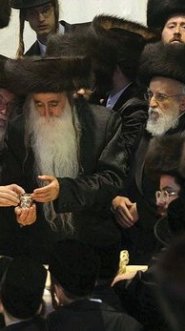
 Ultra-orthodox “head rabbis” conversing on a street in Jerusalem.
A story is recorded in the Talmud (Berakhot 28) in which the most distinguisheddisciple of Hillel, Yohanan ben Zakkai, was dying.
Some years after the destruction of the Temple, the disciples of this importantleader gathered around him as he lay on his deathbed and found him weeping.
They asked him, "Rabbi, you are the light of Israel, the pillar on which welean, the hammer that crushes all heresy. Why should you weep?"
This SecondTemple era sage confessed to his disciples that he was weepingbecause he was about to stand before the "King of Kings, the Holy One,"and he wasn't sure whether he would end up in Paradise or hell!
However, we are confident that, by our faith in the blood atonement of theSuffering Messiah Yeshua (Jesus), our sins are covered and we will end upin Paradise.

Can we be Holy?
"Speak to the entire assembly of Israel and say to them: ÔÇÿBe holy because I,the Lord your God, am holy." (Leviticus 19: 2)
The Kedoshim (Holy Ones) portion of today's Parsha emphasizes holiness.
The word kedoshim comes from the Hebrew word kadosh, which means holy,sanctified, or set apart.
God expects His people to bekadosh (holy) as He is kadosh (holy).
"Make every effort to live in peace with everyone and to be holy; withoutholiness no one will see the Lord." (Hebrews 12:14)
The obvious question is HOW can we be holy?
We must be capable of it, since God would not ask us to do something wesimply can't do.
We know that we are made holy through faith in Yeshua HaMashiach (Yeshuathe Messiah), and that we are sanctified through His blood.
But how is a holy life lived out on a practical, day-to-day basis?
 The streets in the Old City of Jerusalem
The Torah: A Guide to Holiness
Rather than turn to our own manmade idea of what constitutes a holylife, we can rely on the Torah,especially the Ten Commandments, todiscover God's standards of holiness.
The first commandment is twofold: honor one's mother and father, and keepGod's Shabbats (Sabbaths).
The reason these two are given side by side, the rabbis explain, is thathonoring one's parents is the first step towards maintaining good earthlyrelations with our fellow man.
Keeping the Shabbat is the first step in maintaining a good spiritualrelationship with God.
Indeed, this Torah portion makes it plain that loving God and lovingour neighbor is foundational to holy living.
Yeshua confirmed this when He was asked which commandment was themost important.
"ÔÇÿThe most important one,' answered Jesus, ÔÇÿis this: ÔÇÿHear, O Israel, the Lordour God, the Lord is one. Love the Lord your God with all your heart and withall your soul and with all your mind and with all your strength.' The secondis this: ÔÇÿLove your neighbor as yourself.' There is no commandment greaterthan these." (Mark 12: 29 – 31)
 Ornately embroidered velvet Torah mantles cover these precious scrolls ofTorah, which are stored inside a Torah ark
Yeshua's statement in no way obliterates the commandments, it reaffirmsthem;therefore, we simply need to read Torah to discover that loving God andour neighbor as ourselves includes the following:
ÔÇó
Consideration for the poor and needy;ÔÇó
Prompt wages for reasonable hours;ÔÇó
Honorable dealings; ÔÇó No slander or malice;ÔÇó Kindness to the alien or stranger;ÔÇó Sexual morality;ÔÇó Equal justice to rich and poor; and ÔÇó Abhorrence of idolatry.
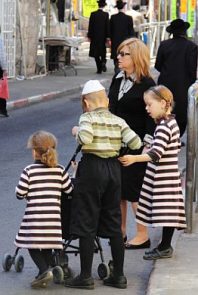 An Orthodox Jewish woman with her children in MeaShearim, one of the largest religious Jewishneighborhoods in Jerusalem.
Holy Conduct in an Unholy World
"You are to be holy to me because I, the Lord, am holy, and I have set youapart from the nations to be my own." (Leviticus 20: 26)
During the Temple times, the Cohen Gadol (high priest) was instructed to weara plate upon his forehead that bore the words "Holy unto the Lord." With hisevery movement, this plate reminded him that He was to be holy.
We also are to remember-when conducting business dealings, meetingstrangers, interacting with family and friends, and sitting by ourselves infront of the television or Internet-that we are to be holy in all our conduct.
"But just as He who called you is holy, so be holy in all you do; for it iswritten: "Be holy, because I am holy." (1 Peter 1:15-16)
May we all lead Holy lives that give glory to the Lord.
